 |
 |
Spanish Word of the Day
| September 4th, 2013 at 7:47:57 PM permalink | |
| Wizard Administrator Member since: Oct 23, 2012 Threads: 241 Posts: 6108 | How would one translate this, El personaje de un muchaco grandullón y adobado, .... In particular, the last word. Knowledge is Good -- Emil Faber |
| September 4th, 2013 at 9:59:35 PM permalink | |
| Pacomartin Member since: Oct 24, 2012 Threads: 1068 Posts: 12569 |
You've misspelled the word. It should be "abobado" abobado: adj. Que parece bobo A cognate of Spanish word "bobo" is the English word "booby" and the word "boob".  |
| September 5th, 2013 at 7:21:54 AM permalink | |
| Nareed Member since: Oct 24, 2012 Threads: 346 Posts: 12545 |
Nova is Latin for new. In modern terms it means an exploding star. In astronomy it means a class of star that increases dramatically in brightness in a short period (not a regular variable star), and it might or might not be blowing up. When it does blow up, it's a Super Nova. Why would new=exploding star? Well, the first such observed phenomenon involved a Super Nova which had, til it blew, been invisible from Earth. The man who noted it and studied it, and this before the telescope was developed, Tycho Brahe, titled his paper "De Nova Stella," or "Concerning the New Star." So the name "Nova" stuck for these types of stars. So there :P Donald Trump is a one-term LOSER |
| September 5th, 2013 at 7:24:44 AM permalink | |
| Nareed Member since: Oct 24, 2012 Threads: 346 Posts: 12545 |
Adobado means covered in adobo. Adobo is a thick paste made with chilies and other things. So I'm guessing Paco's intepretation is correct, in aprticualr in light of the other mispellings in the quote. To wit: El personaje de un muchacHo granduLón y aBobado. Which would mean approximately, not knowing the context and all: the character of a gorilla-like, stupid young man. You migt want to ask the author was they were smoking, too. Donald Trump is a one-term LOSER |
| September 5th, 2013 at 8:23:16 AM permalink | |
| Pacomartin Member since: Oct 24, 2012 Threads: 1068 Posts: 12569 |
From ancient Greece to Brahe's time the idea that anything changed in the heavens was a radical idea. They certainly had no idea that it was exploding, just that it was different and it was not an atmospheric phenomena. If you want to read Wizard's quotes in context they are in: Cuentos que contaban nuestras abuelas (page 43) According to the DRAE the word is spelled "grandullón" in Europe and "grandulón" in America. I assume you know that BrE and AmE have different standard spellings of many words. |
| September 5th, 2013 at 9:23:06 AM permalink | |
| Wizard Administrator Member since: Oct 23, 2012 Threads: 241 Posts: 6108 |
You're right, I misspelled it. It should have been abobado, which is the past participle of abobar. I omitted the H in muchacho too. However, the book does spell grandullón with two Ls. I can provide a screenshot to prove it. SpanishDict accepts that spelling as well.
Given the context, I was hoping for a better picture than that. Knowledge is Good -- Emil Faber |
| September 5th, 2013 at 9:39:37 AM permalink | |
| Pacomartin Member since: Oct 24, 2012 Threads: 1068 Posts: 12569 | As seems typical, the translation follows the European spelling and word choice. This statue is at Plaza at Lucchetti in San Juan, which seems upscale. 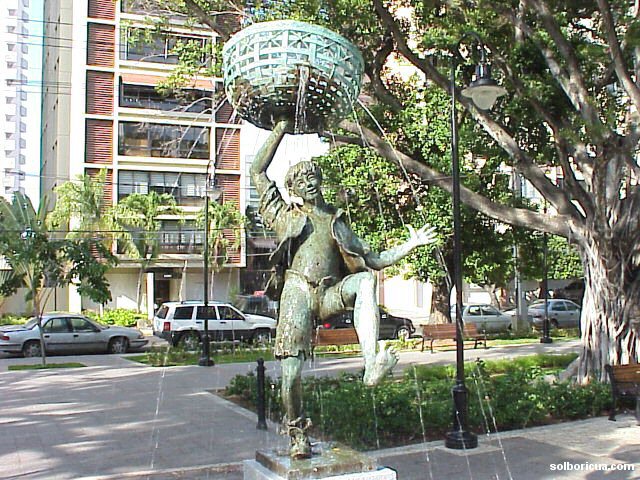 |
| September 5th, 2013 at 7:47:50 PM permalink | |
| Wizard Administrator Member since: Oct 23, 2012 Threads: 241 Posts: 6108 | Sorry to bring up an old topic, but still am still struggling with the title of the book El Día Que Nevaron Tortillas. A college-level Spanish text I've been working through says of the use of se:
That seems to be what is going on in the Tortillas book. The day is de-emphasized, making the tortillas the subject, for which the verb must agree in number. However, if that is right, why isn't the title El Día Que Se Nevaron Tortillas? Knowledge is Good -- Emil Faber |
| September 5th, 2013 at 9:00:17 PM permalink | |
| Pacomartin Member since: Oct 24, 2012 Threads: 1068 Posts: 12569 |
Google Translate certainly seems to have less trouble with the "se" in there. |
| September 6th, 2013 at 6:52:47 AM permalink | |
| Nareed Member since: Oct 24, 2012 Threads: 346 Posts: 12545 |
Because there is no action performed by, or on, any thing. In English you're asking why it shouldn't be "The day tortillas made themselves fall down like snow." Donald Trump is a one-term LOSER |