 |
 |
Spanish Word of the Day
| August 30th, 2013 at 10:59:06 PM permalink | |
| Pacomartin Member since: Oct 24, 2012 Threads: 1068 Posts: 12569 |
Josefa Marmanillo, nicknamed Doña Pepa was a slave from early 18th century who invented the cake. |
| August 31st, 2013 at 6:36:06 AM permalink | |
| Wizard Administrator Member since: Oct 23, 2012 Threads: 241 Posts: 6108 |
Hmmm. I'm not saying you're wrong, but it doesn't make sense in the story I'm reading, in which every character is an animal. I think he is somebody in the world of Ratoncito Perez. Maybe Lupe, mi criada, will be of help this Tuesday. Onto another question, what kind of animal, likely a bird, is a quetzal? The dictionaries say it is the monetary unit of Guatemala. Coincidentally, this is the second time I've seen the word this morning. The first is in this thread. Here is the sentence, ¿Por qué no tendré una cola larga y hermosa como la del quetzal? Knowledge is Good -- Emil Faber |
| August 31st, 2013 at 8:55:02 AM permalink | |
| Pacomartin Member since: Oct 24, 2012 Threads: 1068 Posts: 12569 |
The nickname of the slave may have been a common story animal. It isn't uncommon source for nicknames  The word "quetzal" is from the Aztec language, and is both a bird and the namesake for the money in Guatemala. The 100 quetzel note (largest banknote) is worth less than US$13, and the government is circulating slightly more than US$200 in quetzals per capita. So most of the wealthy people probably keep their money in accounts denominated in US dollars. EDIT: There is a 200 quetzel note, and the government is considering issuing a 500 and 1000 quetzel note. A 1000 quetzal note would be worth more than US$125. It is not clear why this country needs such a large value banknote. Typical to a small impoverished country, Guatemala issues the equivalent of US$3 billion in local currency while keeping $3.8 billion in US dollars in federal reserve. They also keep over $3 billion in other currencies as a hedge against the dollar. |
| August 31st, 2013 at 9:01:06 AM permalink | |
| Nareed Member since: Oct 24, 2012 Threads: 346 Posts: 12545 | Quetzal is not Spanish, but rather some Mesoamerican tongue. Look up Quetzalcoatl, too. Donald Trump is a one-term LOSER |
| August 31st, 2013 at 9:13:02 AM permalink | |
| Pacomartin Member since: Oct 24, 2012 Threads: 1068 Posts: 12569 |
It is a Nahuatl word, the primary language of the Aztecs and the most common indigenous language in Mexico. The Aztecs made it a prestige language so it spread through present day Central America. Presumably most speakers of Mezoamerican languages in Guatemala speak some variant of the Mayan languages. 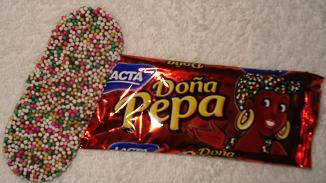 She is pictured on the wrapper of the candy bar that bears her name. |
| September 1st, 2013 at 7:57:38 PM permalink | |
| Wizard Administrator Member since: Oct 23, 2012 Threads: 241 Posts: 6108 |
So far I've bothered my Spanish tutor and two people in Costa Rica and none knew who Doña Pepa was, although they generally seemed to recall hearing the name somewhere. Two more days until I annoy Lupe over this. Onto new business. I was having some trouble with this sentence, No hay mal que por bien no venga, so I put it into Google.translate. It said Every cloud has a silver lining. No particular question here, but it goes to show something about how it works. I'd still be interested in a more literal translation. Knowledge is Good -- Emil Faber |
| September 1st, 2013 at 10:36:37 PM permalink | |
| Pacomartin Member since: Oct 24, 2012 Threads: 1068 Posts: 12569 | I think that it is idiomatic enough that you can't translate it directly. But "there is no bad (things) from which no good, cannot come". hay == there is no venga == cannot come (subjunctive mood)  presumably these kids are dismissed if their teacher shows up late |
| September 2nd, 2013 at 3:19:44 PM permalink | |
| Wizard Administrator Member since: Oct 23, 2012 Threads: 241 Posts: 6108 | How do you say in Spanish: (1) walnut? (2) walnut tree? How would you translate, Él continuaba echado a la sombra del nogal.? Knowledge is Good -- Emil Faber |
| September 2nd, 2013 at 8:53:40 PM permalink | |
| Pacomartin Member since: Oct 24, 2012 Threads: 1068 Posts: 12569 | I know that "Nogales" Arizona means place of black walnut trees. Nogal(es) is a walnut tree(s) Nuece(es) is a walnut nut(s)  "He continued lying in the shadow of a walnut tree." Frankly I would have had trouble figuring it out without reading it in context. Cuando ya el campo estaba arado, Martin anuncio:- Es hora de sembrar las semillas. Pero mientras Catalina caminaba entre los surcos, sembrando las semillas, el continuaba echado a la sombra del nogal. Ella seguia sin quejarse. Cuando el trigo crecio y las espigas estaban doradas Martin fue a buscar a Catalina. |
| September 3rd, 2013 at 3:48:11 AM permalink | |
| Wizard Administrator Member since: Oct 23, 2012 Threads: 241 Posts: 6108 |
I can't find nuece in the dictionary. However, it seems to indicate that nuez is both the general term for a nut and for a walnut specifically. There must be a way to specifically indicate a walnut, as well as nuts in general. For example, what if I went to a restaurant and warned the waiter not to bring me anything with nuts because I'm allergic. Then he brought me something with hazelnuts. After almost dying and complaining about it, he said "I thought you were only allergic to walnuts." Knowledge is Good -- Emil Faber |