 |
 |
Useless Fact For Today
| July 31st, 2013 at 12:04:43 PM permalink | |
| Pacomartin Member since: Oct 24, 2012 Threads: 1068 Posts: 12569 |
It might be easier if I posted a chart with only one variable (temperature) as a function of altitude. The scales are more familiar as centigrade and Fahrenheit for temperature, and kilometers and miles for altitude. 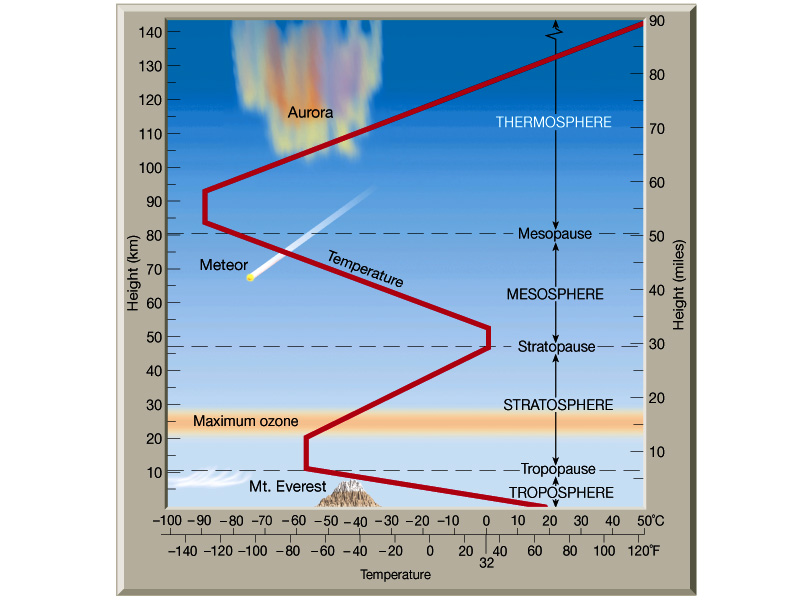 The three zones where temperature is basically uniform are traditionally called "pauses". At 50 km high the temperature returns is now above freezing (about 50 degrees Fahrenheit), unfortunately it is impossible to fly that high in a jet. The highest current world absolute general aviation altitude record achieved by a manned air-breathing jet propelled aircraft is 37.65 km set by Alexandr Fedotov, in a Mikoyan Gurevitch E-266M (MiG-25M), on 31 August 1977. Outer Space was considered 50 miles of altitude by the Air Force, but the accepted international definition is now 100 km. Space Ship One flew to 112 km in October 2004 to win the US$10 million Ansari X Prize. Virgin Galactic will be taking tourists above 100 km so that they qualify as having gone into outer space. There is a difference between the definition of temperature and heat. At very high altitudes there is no heat since atmospheric density is incredibly low and the "mean free path" or the distance on average a molecule can go before colliding with another molecule. However, temperatures are very high. |
| July 31st, 2013 at 12:28:35 PM permalink | |
| odiousgambit Member since: Oct 28, 2012 Threads: 166 Posts: 6566 |
My understanding is that it cools by infrared radiation, which is why a cloudless night cools things off so much more quickly. There must be other radiation wavelengths as well, but objects have to be very hot to shed visible light, for example. I'm Still Standing, Yeah, Yeah, Yeah [it's an old guy chant for me] |