 |
 |
Useless Fact For Today
| July 29th, 2013 at 3:55:12 AM permalink | |
| odiousgambit Member since: Oct 28, 2012 Threads: 166 Posts: 6566 | Something I stumbled across today, "Temperature increases with height in the thermosphere" [highest part of Earth's atmosphere unless you include the Exosphere where molecules 'no longer behave like a gas']. IMO wikipedia, where I looked to confirm this, does not explain why temperature increases adequately. http://en.wikipedia.org/wiki/Earth%27s_atmosphere Image is to scale, excepting objects [wikipedia] 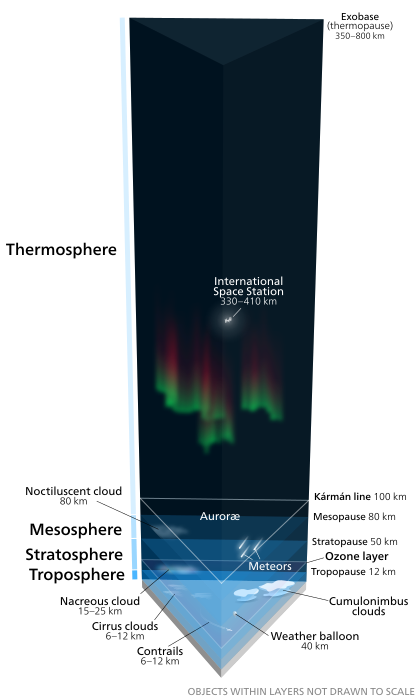 I'm Still Standing, Yeah, Yeah, Yeah [it's an old guy chant for me] |
| July 29th, 2013 at 6:32:17 AM permalink | |
| Face Member since: Oct 24, 2012 Threads: 61 Posts: 3941 | My initial idiot’s explanation is “heat rises, duh” ;) I’m guessing it’s the radiation. There’s nothing up there to save you from the full force of the sun. The moon has about a 400* swing from dark side to light side, so I imagine up in the thermosphere, where the atmosphere is similar to that of the moon’s (that is, practically nothing) you’d experience the same thing. Be bold and risk defeat, or be cautious and encourage it. |
| July 29th, 2013 at 7:02:33 AM permalink | |
| odiousgambit Member since: Oct 28, 2012 Threads: 166 Posts: 6566 |
good guess, but note the wikipedia writer's explanation,
Notice that this is extremely hot, and can be measured, but " the gas molecules are so far apart that temperature in the usual sense is not well defined." Think of spraying your finger with the sparks of a cigarette lighter flint; molten metal at 1000 degrees or so, but there is not much mass and little effect. Perhaps you are right, the molecules are extremely agitated by radiation and more so as you go up. Perhaps the wikipedia writer should not use the word "result" but means to say only that the low density of molecules means counter-intuitive effect. You know, we could test this. I have done this before: you simply go in to the wikipedia page and try to make a statement that makes sense and see if it stands. Anymore, though, you are at risk for robo-citation as a source of vandalism ... that risk might be small here. There is also a chance that an incorrect assertion will stand if no one [like the various authors] keeps an eye on the page. Want to try it? I'm Still Standing, Yeah, Yeah, Yeah [it's an old guy chant for me] |
| July 29th, 2013 at 9:16:05 AM permalink | |
| Face Member since: Oct 24, 2012 Threads: 61 Posts: 3941 | While I’d not worry about the repercussions from rustling Wiki’s jimmies, questions like these are a treasure to me as they give me a chance to try and think it out, and I’d not want to deprive myself this opportunity. Questions like these also make me long for the days when any old off topic post could be put on WoV, because I’ve learned much from its members asking questions just like these. This would also hit on a big question of mine that I’ve not yet been able to pose. But anyways… I think the problem we’re not immediately seeing is the same one Doc tried to teach me in my “hole through the Earth” thread. Quite simply, thermodynamics is a bitch lol. All the things we think of relating to heat and temp sort of has two meanings – a common one we use, and a scientific one that’s hard to wrap the mind around. I guess I’ll start with a question I posed from that same thread. I saw a documentary on space travel, and the guy had a 3“x3”x3” cube of the foam or ceramic insulation that’s on the outside of the shuttle. He heated it up with a blow torch until it glowed red hot, then picked it up with his bare fingers and held it in his bare palm. Was it “hot”? I don’t think that question was ever answered, but many others were. “Heat” the way we think of it commonly is the rate of exchange of thermal energy (and these are my words from what I remember from Doc’s lesson, so I could be completely wrong =p) That cube wasn’t “hot” because it transferred the energy very slowly. I think the same concept is at play here. Take your lighter spark idea. Now imagine it’s not like the typical spark that burns out immediately, but rather all those molten pieces of flint stay at 1,000* or whatever. Now take all those pieces of spark, and distribute them evenly throughout your whole house. Is your house hot now? I think that’s what’s at play here. Heat in the common sense is the measure of energy contained within a body. Way up there, the “body” barely exists. Whereas here the bodies (molecules) are literally piled upon each other like sands on a beach, up there they can go a mile before they run into another of their kind. So while the pieces are hot as molten metal, it’s not very hot from a common standpoint because there are so few, just like our floating, eternally burning pieces of spark dispersed through your house would not make your house “hot”. That’s the best I can do for now. I’d imagine if radiation somehow did not affect the matter that makes up ourselves and we went up there, it’d be very cold indeed because those particles, while superhot, are so few. Hot-but-not-hot. That make sense? Be bold and risk defeat, or be cautious and encourage it. |
| July 29th, 2013 at 9:39:04 AM permalink | |
| odiousgambit Member since: Oct 28, 2012 Threads: 166 Posts: 6566 | this is going down another avenue for me than when I started. Now I'm thinking, which is it correct to say: it is 'very cold' or 'very hot' in near space? In terms of heat energy, clearly it is very cold. But in the way that temperature is measured, that's not the same as heat! So, it could be correct to say it is very hot! That'd make a good trivia question, but one that would be considered unfair I think. I'm Still Standing, Yeah, Yeah, Yeah [it's an old guy chant for me] |
| July 29th, 2013 at 12:11:07 PM permalink | |
| odiousgambit Member since: Oct 28, 2012 Threads: 166 Posts: 6566 | update: there is a page for the Thermosphere itself and it seems Face nailed it.
http://en.wikipedia.org/wiki/Thermosphere HOWEVER, skimming this page, I haven't found an explanation for the temperature inversion.... an explanation I find adequate, anyway I'm Still Standing, Yeah, Yeah, Yeah [it's an old guy chant for me] |
| July 29th, 2013 at 12:39:08 PM permalink | |
| Face Member since: Oct 24, 2012 Threads: 61 Posts: 3941 |
Woo-hoo! Not bad for a redneck ;)
I highly doubt this is the answer, but perhaps this may spark something, kind of give you that boost to the idea just out of your reach. I’m reminded of the stratification of a body of water, as I wrote about in “FishingWF”. The top layer gets the most sun and absorbs the most energy, heating it much more quickly than the depths where the sun has difficulty reaching. Just like a swimming pool, the top thin layer is warm, then BOOM, like a knife edge the temp drops significantly. The difference is so severe that these layers can no longer mix. Even though it’s all water and chemically homogenous, the density is so dissimilar due to the heat that it’s almost like oil and water. Same thing? Obviously where we live gets protected and most of the energy is reflected back into space. But the higher you go, the more matter is just getting annihilated by solar radiation. And maybe, perhaps, it could be, that since the matter is so…what’s the opposite of dense?... sparse, I guess?... say a tiny molecule of O2 gets nailed with radiation and superheats… it’s all by itself, unable to transfer that heat to another body by contact. It's not "mixing" with anything else, not even itself. The higher you go, the more alone these molecules are, and the less likely they are to dissipate their energy unto another; they just keep floating around getting hotter and hotter. I dunno. It’s fun to think =) Be bold and risk defeat, or be cautious and encourage it. |
| July 29th, 2013 at 3:01:42 PM permalink | |
| Pacomartin Member since: Oct 24, 2012 Threads: 1068 Posts: 12569 | It always helps to look at a US Standard atmosphere 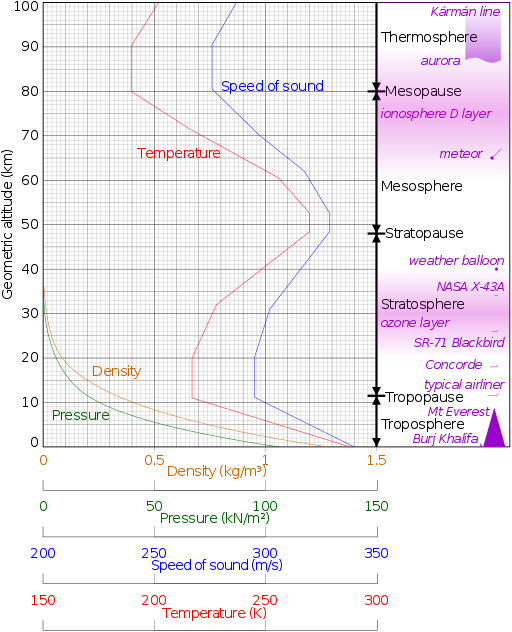 Kelvin to Fahrenheit 300 Kelvin = +80.3 degrees F 256 Kelvin = -01.1 degrees F (near freezing) 217 Kelvin = -69.1 degrees F (about temperature at Tropopause which most commercial flights never exceed). ============================= A standard atmosphere is 59 degrees on the ground drops 3.575 degrees F every 1000' 36 000' it is -69.7 degrees F with loss of -77.70% in pressure maintains same temperature of -69.7 degrees F until 65 000' where pressure is -94.60% of ground level Then begins to climb in temperature. |
| July 31st, 2013 at 6:59:40 AM permalink | |
| odiousgambit Member since: Oct 28, 2012 Threads: 166 Posts: 6566 |
At first I thought the two charts were in conflict; turns out this chart stops at the lower part of the Thermosphere. Some interesting things. Density and pressure practically vanish at around 35 km. I think it is probably fair to consider this also the point at which "the usual sense" of what temperature means also vanishes. It seems also that the temperature above 20 km increases for a spell, then decrease again, to increase again in the upper Troposphere. I think I can say from what I know about science is that what is being measured as "temperature" is actually the velocity of whatever molecules exist. The text in Wikipedia indicates that such molecules start to travel in terms of kilometers before striking another molecule at these near-space altitudes. I just remember studying that temperature is a measure of the agitation of molecules, or the vibration of those molecules at the molecular level [which is not the same thing as vibration in the usual sense]. At that molecular level, the molecules are traveling at a certain velocity as well, but contacting other molecules also at the molecular level, definitely vibration in a certain sense. Molecular level interaction is not what is going on at 35 km or so, and above. Measured temperature [velocity I assume] must involve some fancy instruments! Scientists evidently value keeping the same terminology for these measurements they take as is used at low elevations, while at the same time admitting the common meaning of temperature no longer pertains. There must be a lot of data, after all the Space Station is right smack dab in the middle of this Thermosphere. I'm Still Standing, Yeah, Yeah, Yeah [it's an old guy chant for me] |
| July 31st, 2013 at 9:39:13 AM permalink | |
| Face Member since: Oct 24, 2012 Threads: 61 Posts: 3941 | Glad you tackled it lol. While thankful for his contribution to give insight without giving the answer, I’m always taken aback by informartin* and didn’t know how to proceed. *informartin: Noun – Information supplied by Pacomartin that’s so above your head, you’re stopped dead and struck dumb by it. In any case, this has lead nicely into that question I alluded to earlier, the one I never asked. Like you, OG, my understanding of temp is the same as yours as far as the vibrating goes. Specifically, "temperature is the measure of kinetic energy within matter" or something close to that. And when they contact another particle, that energy gets transferred, blah blah blah. BUT… if space is nothingness, how does the Earth radiate energy out? Surely the energy must leave, yes? Or else wouldn’t the Earth just heat and heat and heat forever? I can kind of wrap my head around how the Earth gets warm, what with the radiation particles from the sun striking it. But how does it cool? What send that energy back away from us, what does that thermal energy turn in to, what process allows us to cool? This is largely why I never entered the Climate Change debate on WoV. Be bold and risk defeat, or be cautious and encourage it. |