 |
 |
Bombardier CS100
| October 26th, 2017 at 4:19:31 PM permalink | |
| Pacomartin Member since: Oct 24, 2012 Threads: 1068 Posts: 12569 |
The original B747-100 only had a range of 4,620 nautical miles, and was the version of the B747 that was most popular with USA airlines. As I said earlier, outside of the original -100 model whose orders were placed in the mid 1960's, the bulk of the B747s were sold in Asia and Europe.
5200 nmi around LAX LAX NRT 4,737 nm LAX LHR 4,741 nm OSL NRT 4,540 nm 5200 nmi around LHR LHR DEL 3,642 nm LHR JNB 4,884 nm LHR ICN 4,797 nm LHR PEK 4,415 nm |
| October 27th, 2017 at 2:36:46 AM permalink | |
| Pacomartin Member since: Oct 24, 2012 Threads: 1068 Posts: 12569 |
Yes, of course, if you are comparing plane to plane. For instance look at the results of these two fuel efficiency tests done in 2016. Airbus A321NeoLR (6,300 km) 2.99 kg/km 154 seats Airbus A330neo-900 (6,200 km) 6.00 kg/km 310 seats The wide body plane burns fuel at twice the rate of the narrow body, but it carries almost exactly twice as many seats in the test. So on a per seat basis they both burn fuel at 2.4 Liters/100 km or (97 mpg‑US). The Boeing 797 would encourage more wide body equipment on domestic flights, helping to ease runway congestion. Current Wide Body flights at San Diego Airport British Airways to London Boeing 777 or Boeing 747 Japan Air Lines Co. to Tokyo B787-800 Dreamliner Hawaiian Airlines Inc. to Honolulu Airbus Industrie A330-200 Delta Air Lines Inc. to Atlanta Boeing 767-400/ER (less than daily) Hopefully the B797 would be used on domestic connections between San Diego airport and hubs like Atlanta, Chicago, and Dallas Fort Worth. Southwest flies 82.3% of the flights into San Diego with the 143 seat airplanes and the remainder with the 175 seat airplane. The more they use the larger airplane, the less runway congestion. |
| October 27th, 2017 at 7:49:38 AM permalink | |
| Nareed Member since: Oct 24, 2012 Threads: 346 Posts: 12545 |
Well, it depends on the model. The A300 could carry slightly more passengers than the A321. It's all relative.
If only. The point about fuel efficiency is that airlines would rather cram 300 people in a narrow body rather than a wide body. This may complicate Boeing's task with the 797 along the way. Donald Trump is a one-term LOSER |
| October 27th, 2017 at 12:04:43 PM permalink | |
| Pacomartin Member since: Oct 24, 2012 Threads: 1068 Posts: 12569 |
First of all, I don't think we will ever see a narrow body plane with 300 seats. The highest seating capacity of a narrow-body aircraft is 295 passengers in the Boeing 757–300, and I don't think they are going to try and outdo that 737 MAX 10 can seat 230 max and an A321neo can seat 240 max. AFAIK these are the most densely packed commercial. 228 seats Spirit Airlines Airbus A321-200 220 seats Volaris Airbus A321-200 Secondly, the maximum packing configuration tends not to make the most money. Southwest added the Boeing 737-800 to its fleet on April 11, 2012 with 175 seats and began transcontinental nonstop flights. But in over 5 years it still has only a tiny share of the market as passengers prefer roomier configurations. Southwest average stage length is still about 1000 miles. Flights 2000-2999 miles to any airport in California (domestic and international) - % of seats -airline names - average number of seats 25.9% United Air Lines Inc. 180 19.5% American Airlines Inc. 163 15.7% Delta Air Lines Inc. 186 9.3% JetBlue Airways 155 8.1% Virgin America 148 4.9% Hawaiian Airlines Inc. 276 4.6% Alaska Airlines Inc. 165 3.7% Southwest Airlines Co. 157 8.27% other |
| October 27th, 2017 at 1:04:32 PM permalink | |
| Nareed Member since: Oct 24, 2012 Threads: 346 Posts: 12545 |
I seriously hope so.
Close enough. and that was before the era of 28" pitch ;) So I'll restate: airlines prefer to cram 295 passengers in a narrow body than in a wide body. So there :)
We have fewer and fewer roomier configurations as time goes on. In a few years, it may no longer be a factor :( Now let me present a horrible thought: Aircraft have pressurized cargo holds (not that horrible, don't worry). as fewer people check bags due to fees, all that cargo hold space is wasted. Oh, some is taken up by actual cargo, no doubt. But how about increasing bag fees to really insane levels and put seats, with carry on overhead bins, in the erstwhile cargo holds? Infra Basic Economy! I'd be surprised if the modern sadists who run the ULCCs haven't explored this possibility already. IMO, they haven't implemented it as yet because boarding and de-boarding times would increase (hard to make a regular people door on the lower fuselage) Donald Trump is a one-term LOSER |
| October 27th, 2017 at 4:45:03 PM permalink | |
| Pacomartin Member since: Oct 24, 2012 Threads: 1068 Posts: 12569 | I still think the idea of Boeing moving out of the narrow body business entirely makes some sense. In eight years they should have the 797 available for sales, and they may have a company selling nothing but 777,787, 797 wide bodies, and let Airbus duke it out with Comac, Mitsubushi, Embraer and Komsomolsk-on-Amur for the low margin jets. Orders, deliveries and unfilled orders for 2016 by program are as follows: Deliveries 2016 737 490 747 9 767 13 777 99 787 137 I think in a decade they could be deliveries 300 797s a year. |
| October 28th, 2017 at 5:13:52 PM permalink | |
| Nareed Member since: Oct 24, 2012 Threads: 346 Posts: 12545 |
I'm sure Airbus would love that. The question is: Is Boeing reckless enough to gamble the company on a MoM design? Granted Airbus has the A380 as an albatross around their neck, but otherwise their doing well. And now they own the only new design for a mainline, if small, narrow body in decades. Not to mention years fo experience. Other than the A380, they're doing well. Donald Trump is a one-term LOSER |
| October 28th, 2017 at 6:45:33 PM permalink | |
| Pacomartin Member since: Oct 24, 2012 Threads: 1068 Posts: 12569 |
Well it's not just the MoM 797. They have to work on the new 777X. Plus in ten years the 787 will be fading out. They probably have 7 years of production on the 737Max. The question is can they keep up with all the development to stay ahead in widebodies, and at the same time do a narrowbody clean slate design to catch and surpass all the other groups. They've been shedding the smaller planes throughout the years, is it really that hard to believe that they will shed narrowbody aircraft completely in a decade. The first generation of B737 had it's first flight on April 9, 1967. It was built to counter the dominant DC-9 with it's first flight on February 25, 1965. The second generation of B737 had it's first flight on February 24, 1984, and it already had the odd shaped engine to keep backwards compatibility with the previos generations.  The A320 had it's first flight 22 on February 1987. The innovative techniques like fly by wire would spawn a third generation of B737. The third generation of B737 had it's first flight on February 9, 1997. We all know that Boeing planned a clean slate design, but instead reacted to the new engine option and announced a fourth generation with first flight on January 29, 2016. After 50 years, virtually no one thinks there is a 5th generation, but I think it would be more of a gamble to spend tens of billions generating a new clean slate design against so much competition for a plane that they will probably have to produce a 1000 a year to get to pay off. I think it will be less of a gamble to make 300 MoM planes a year. |
| October 29th, 2017 at 9:55:26 AM permalink | |
| Nareed Member since: Oct 24, 2012 Threads: 346 Posts: 12545 |
I think you just asked the same question I did: does Boeing bet the company on the MoM plane? See, we know there will be a place in the market for narrow bodies and wide bodies. We know airbus will develop new wide bodies. If Boeing cedes the narrow body market to Airbus, then it has the MoM as the unique product to give it an edge, and nothing else. So the company would be wagered on the MoM (and I still think they'll just update the 767). Less risky, somewhat, would be to invest heavily on Embraer and give them the narrow body jobs. But that won't happen until at least Nov. 2018. Donald Trump is a one-term LOSER |
| October 29th, 2017 at 12:44:37 PM permalink | |
| Pacomartin Member since: Oct 24, 2012 Threads: 1068 Posts: 12569 |
They still have a dominant position in larger widebodies. As I understand it, about half of Boeing's profits come from the 777-300ER. But it is pretty clear that Boeing has lost the battle for larger narrowbodies. The MAX-7 MAX-9 and MAX-10 aren't worth bupkis as far as Boeing is letting us know. The MAX-8 should keep the production lines busy for another 7 years at least. 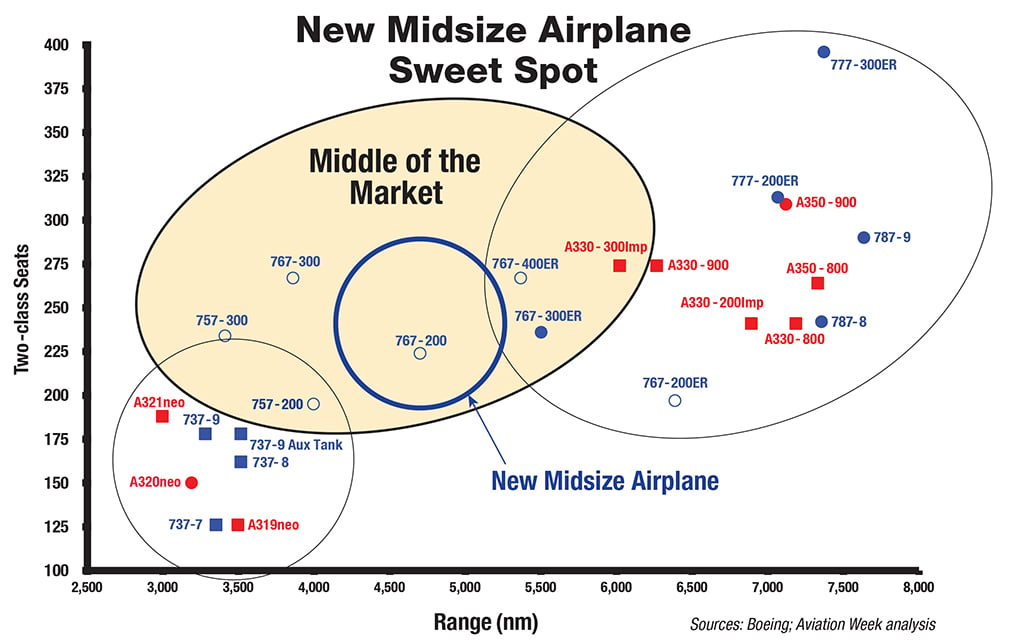 |